
A Beginner's Blueprint for Investing: The SPY and QQQ Strategy
How two simple ETFs and consistent investing can quietly build wealth over time.

For someone just starting out in investing, the financial world can feel overwhelming.
There are thousands of stocks, endless opinions and headlines declaring the market is about to crash one week and soar the next.
It’s enough to make many people do nothing at all. But beneath all that noise, there is a surprisingly simple strategy that has worked for millions of investors over the past several decades.
Buy broad market index ETFs, invest consistently, and hold them for the long term.
Two ETFs in particular — SPY and QQQ — have become foundational building blocks for beginner portfolios. Combined with a disciplined strategy like dollar-cost averaging, they offer a straightforward and powerful framework for building wealth over time.
You don’t need to predict markets or pick individual stocks or get caught up in the news of the day.
Just follow this simple system and the rest will take care of itself.
Understanding Exchange-Traded Funds
Exchange-Traded Funds, commonly called ETFs, are one of the most important innovations in modern investing.
At their core, ETFs are investment funds that hold a basket of assets, typically stocks or bonds. Instead of buying shares of individual companies one at a time, investors can buy a single ETF that owns hundreds or even thousands of companies.
ETFs trade on stock exchanges just like individual stocks, meaning they can be bought or sold throughout the trading day.
For beginner investors, ETFs offer several major advantages:
Instant diversification — A single purchase can provide exposure to hundreds of companies.
Low costs — Many index ETFs charge extremely small annual fees — often less than one-tenth of one percent.
Transparency-Most ETFs disclose their holdings regularly, so investors know exactly what they own.
Simplicity-Instead of trying to identify the next winning company, investors can simply own the market itself.
For many people, this is a much more practical approach than attempting to pick individual stocks — a task that even professional investors often struggle with.
SPY: The Foundation of Broad Market Investing
One of the most widely used ETFs in the world is SPY, the SPDR S&P 500 ETF.
Launched in 1993, it was the first ETF ever created. Today it remains one of the most heavily traded securities in global markets.
SPY tracks the S&P 500 Index, which includes 500 of the largest publicly traded companies in the United States.
Holdings span every major sector of the economy — technology, healthcare, financials, consumer goods, industrials, and more — providing comprehensive exposure to American business.
These include companies like:
Apple
Microsoft
Amazon
Berkshire Hathaway
Johnson & Johnson
JPMorgan Chase
By owning SPY, an investor effectively owns a small piece of 500 leading companies without the complexity of managing individual positions.
The expense ratio of 0.0945% means that for every $10,000 invested, annual fees amount to less than $10. Liquidity is exceptional, with millions of shares changing hands daily.
Historical performance has rewarded long-term holders. Over extended periods, the S&P 500 has delivered average annual returns of approximately 10%, though individual years vary significantly. This track record, combined with low costs and broad diversification, makes SPY a cornerstone holding in many portfolios.
QQQ: Concentrated Exposure to Technology and Innovation
While SPY offers broad exposure to the market, QQQ provides more concentrated exposure to the companies driving modern innovation.
Launched in 1999, QQQ tracks the Nasdaq-100 Index, which includes the 100 largest non-financial companies listed on the Nasdaq exchange.
Many of the world’s most influential technology companies are major holdings in the fund, including:
Apple
Microsoft
Nvidia
Amazon
Alphabet
Meta
Tesla
As a result, QQQ has a much stronger technology and growth orientation than SPY.

This concentration has historically produced strong long-term returns, particularly during periods of technological expansion. In the recent tech-driven era, the QQQ has averaged between 15–20% annually. However, it also means QQQ can experience larger swings during market downturns — (2022: -32%).

In simple terms: SPY represents the broad U.S. economy and QQQ represents the innovation engine of modern technology and growth companies.
Many investors choose to own both.
The Mechanics of Dollar-Cost Averaging
Choosing sound investments is only part of building wealth. The method used to invest also plays an important role.
One of the most widely recommended strategies for long-term investors is dollar-cost averaging.
The principle is straightforward. Instead of investing a large sum all at once, investors contribute a fixed amount of money at regular intervals regardless of current market conditions.
For example, an investor might invest one hundred dollars every month into SPY or QQQ. When markets are high, that amount purchases fewer shares. When markets decline, the same contribution buys more shares.
Over time, this process smooths out the impact of market volatility and produces an average purchase price across many different market conditions.
Perhaps even more valuable is the psychological benefit. Dollar-cost averaging removes the temptation to guess when markets will rise or fall. Instead of trying to predict the perfect entry point, investors simply continue investing consistently.
That consistency is often what ultimately drives long-term success.
The Mathematics of Consistent Investing
One of the most powerful forces in finance is compound growth.
When investment returns are reinvested and allowed to accumulate over time, small contributions can gradually grow into substantial sums.
Imagine an investor contributing one hundred dollars each month over twenty years. The total amount invested would be twenty-four thousand dollars.
If those contributions earned an average annual return of eight percent, the portfolio would grow to roughly fifty-nine thousand dollars. At ten percent returns, the value would approach seventy-six thousand dollars.
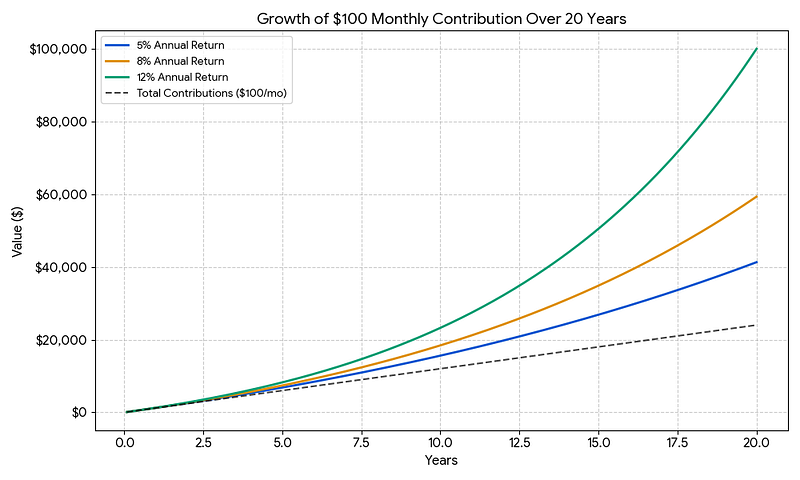
The longer the time horizon becomes, the more powerful compounding becomes. Over thirty or forty years, consistent investing can produce results that far exceed the original contributions.
This is why time is often described as an investor’s greatest advantage.
Dividend Reinvestment and Compounding
Both SPY and QQQ distribute dividends generated by the companies they hold.
Although these dividends are relatively modest — generally around one to two percent annually — their reinvestment can significantly enhance long-term returns.
When dividends are automatically reinvested, they purchase additional shares of the ETF. Those new shares then generate dividends of their own in future periods. Over time, this creates a compounding cycle that steadily increases the size of the portfolio.
Many brokerage platforms allow investors to enable automatic dividend reinvestment at no additional cost. While the impact may seem small in the early years, the cumulative effect can become meaningful over decades.
Understanding Market Volatility
Even the most straightforward investing strategy involves periods of uncertainty.
Markets do not rise steadily year after year. Periods of growth are often interrupted by corrections, recessions, and occasional market crises.
During these moments, many investors feel the urge to abandon their strategy and move to cash. History suggests that this is often the most costly mistake investors make.
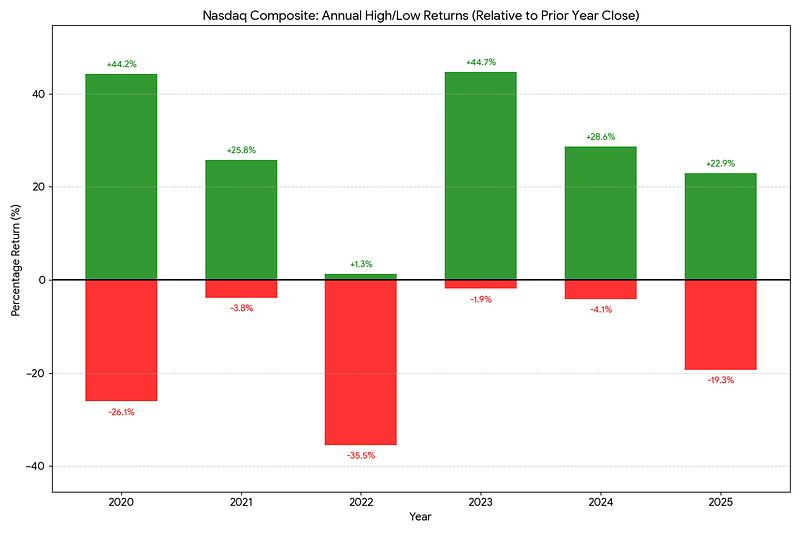
Market downturns are not an anomaly; they are a normal part of long-term investing. Investors who maintain consistent contributions during these periods are often purchasing shares at lower prices, positioning themselves for gains when markets recover.
In many cases, the investors who succeed over long periods are not those who predict markets accurately, but those who remain disciplined when conditions become uncomfortable.
Concentration Risk and Overlap
While SPY and QQQ provide exposure to many companies, a large portion of their value is concentrated in a relatively small group of stocks. Because both funds are weighted by market capitalization, the largest companies — such as Apple, Microsoft, Nvidia, Amazon, Alphabet, and Meta — make up a significant share of each ETF.
There is also considerable overlap between the two funds. Many of the same companies that dominate the Nasdaq-100 are also among the largest holdings in the S&P 500. As a result, investors who hold both SPY and QQQ are increasing their exposure to many of the same large technology companies.
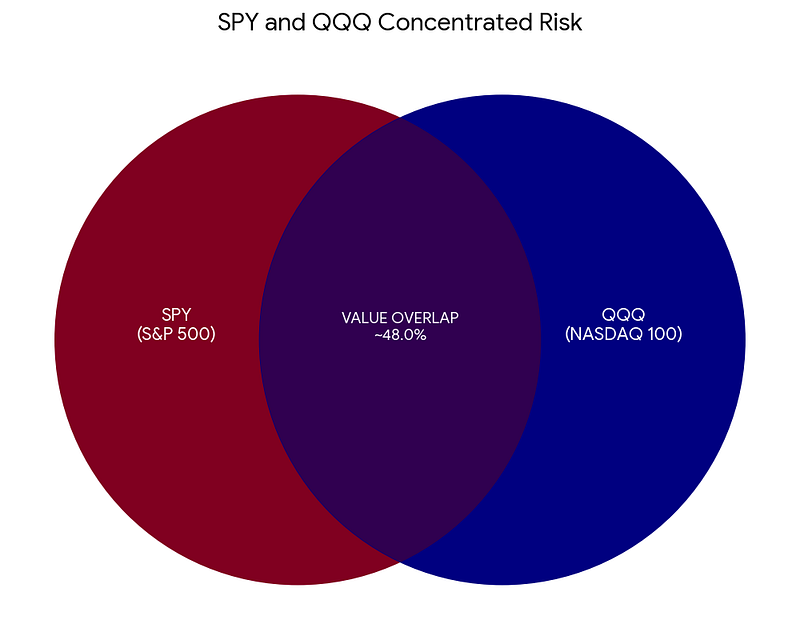
This isn’t necessarily a drawback, but it does mean that the performance of both funds is heavily influenced by a small group of dominant firms in today’s market.
Building a Simple Investment System
Implementing this strategy does not require complicated decisions.
The first step is determining a contribution amount that can be invested consistently. Even modest contributions can become meaningful over time when combined with compounding.
Next comes choosing an investment schedule. Many investors find that monthly contributions aligned with their paychecks work well.
Finally, investors must decide how to allocate between SPY and QQQ. Some prefer a balanced approach, while others tilt more heavily toward the broader diversification of SPY.
Once these decisions are made, automation can simplify the process. Automatic transfers from a bank account into a brokerage account can ensure that investments continue regardless of market conditions or personal distractions.
In many ways, the most effective investment system is the one that requires the least ongoing attention.
Final Thoughts
Successful investing does not require extraordinary insight or constant market analysis.
SPY and QQQ provide exposure to hundreds of the world’s most influential companies. Dollar-cost averaging removes the pressure of market timing. Dividend reinvestment accelerates the power of compounding.
Taken together, these principles form a remarkably simple framework for long-term investing.
The mathematics behind the strategy are well understood. The challenge lies not in understanding the approach but in maintaining the discipline to follow it over time.
For investors willing to contribute consistently and remain patient through market cycles, a simple system like this has historically proven to be more than enough.
Have a question about this article, drop it in the comments. We read every one.
Disclaimer: This content is for educational purposes only and does not constitute personalized financial, investment, or legal advice. Investing involves risk, including possible loss of principal. Past performance does not guarantee future results. The projections presented are hypothetical illustrations based on historical averages and may not reflect actual future performance. Readers should conduct independent research and consider consulting a qualified financial advisor before making investment decisions.