
The Bitcoin Dream Just Collided with Math
Why the world’s most famous asset now faces a hard ceiling, fading speculation, and an 80% chance of long-term irrelevance.

As someone who has struggled to understand Bitcoin and the rest of the crypto markets, I have watched as it march on and on creating crypto millionaires and even billionaires. Truth be told, I still struggle and remain a skeptic — my original article here: Seriously — Can Someone Explain Why I Need To Own Crypto?.
But I have to recognize that Bitcoin has refused to die. It has real use cases — I’m thinking of Russia funding its war with the Ukraine via untouchable Bitcoin to skirt international sanctions or off-balance sheet transfers, payoffs etc. Or another example I heard, about an ex-husband who kept his secret Bitcoin out of the divorce proceedings.
So yes, these are real use cases however illicit they may be.
Bitcoin may be more difficult to kill than a cockroach.
But the year is almost over, and high-flying expectations are starting to be a real miss.
The Great 2025 Miss — A Forecasting Faceplant
Mid-2025 Bitcoin excitement was in a fever pitch.
Bitcoin had ripped past $100K after the halving. FOMO was taking hold with the Boomer dollars and now ETFs were making it easy.
Trump flirted with a “crypto reserve.” AI stocks couldn’t miss.
Here are a some of financial guru’s predictions for 2025:
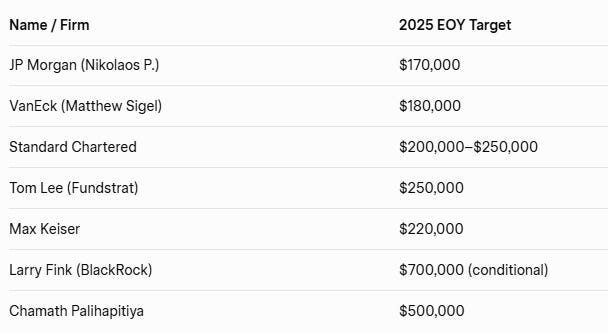
2025 Year-End Bitcoin Predictions far from December 2025 pricing: ~90,000
Miss distance? 100% — 700%. These prognosticators are individuals and firms managing trillions, and yet even the pros can get caught up in the hype.
What is more troubling for the hardcore crypto advocates, is that 2025 was the year Bitcoin went mainstream — regulatory acceptance, ETFs, Futures, Derivatives. The big players like Vanguard, Fidelity and JP Morgan have even reversed their anti-crypto stance probably more enamored by the humongous fees than the fight against the man.
The Maturation of Bitcoin — From Explosive Upside to Bounded Reality
For most of its life, Bitcoin behaved like a renegade asset class.
Early adopters didn’t invest — they bought lottery tickets. And to be fair, the math supported it.
2010–2013: Bitcoin rose roughly 50,000,000% (yes, with seven zeroes).
2013–2017: Another 6,000% explosion.
2017–2021: A more modest-but-still-insane 1,800% run.
2021–2025: A choppy, volatile grind from $69K down to $16K, then back to $126K, and now settling around $90K–$95K.
There’s a clear pattern here:Each cycle produces lower highs, smaller multiples, and fewer life-changing returns.
The early days rewarded anyone brave (or lucky) enough to buy when Bitcoin was young, fragile, and wildly misunderstood. Today? Bitcoin is one of the most analyzed, institutionally monitored, regulated, and derivative-surrounded assets on the planet. It’s not a secret anymore — it’s a product.
And once something becomes a product, the returns compress.
Just look at the curve:
Going from $1 → $1,000 is easy if no one understands you.
Going from $1,000 → $100,000 is harder when hedge funds, regulators, and ETFs are all involved.
Going from $100,000 → $1,400,000 (the mathematical ceiling we’ll get to later) requires a global monetary reshuffle.
And it creates a new, more uncomfortable question for Bitcoin holders:
What happens to returns now that Bitcoin is a mainstream asset?
The Math Problem Bitcoin Can’t Escape — When the Ceiling Stops Rising
For years, the loudest voices in the ecosystem-Michael Saylor, Cathie Wood, ARK Invest, Anthony Pompliano, the entire laser-eye priesthood-made their reputations by projecting grand, world-reshaping price targets:
Saylor: “Bitcoin goes to infinity.”
ARK / Cathie Wood: $1,500,000–$2,400,000 by 2030 (later revised down to $1,200,000).
Maxis on X: $5M, $10M, $100M per coin — just pick your favorite scenario.
The problem with these predictions isn’t ideology. It’s arithmetic.
Once Bitcoin’s market cap crossed $1 trillion, the dream of unlimited upside ran into a brick wall: the total value of assets it wants to replace.
So, let’s run the math that the hopium never includes.
The Gold Replacement Model — Bitcoin as Store-of-Value King
This is the cleaner and more intuitive model:If Bitcoin “flips” gold as the world’s dominant store of value, what’s one coin worth?
Here are the inputs (Dec 2025 assumptions):
Total above-ground gold: 7.01 billion oz
Gold price: ~$4,200 per oz
Total gold market value: ≈ $29.44 trillion
Bitcoin supply cap: 21 million coins
Formula: $29.44 trillion ÷ 21 million BTC = ~$1,402,000 per Bitcoin
That’s your theoretical BTC ceiling: ~1.4M per coin.
Even in the absolute best-case scenario-where Bitcoin replaces gold’s entire store-of-value function (which is a fantasy in itself)-the upside from today is roughly 15×.
Strong? Yes.
Infinite? No.
Cycle-changing? Also no.
This is the first splash of cold water.
The Monetary Replacement Model — Bitcoin as Global Base Money
This is the model Saylor and the hardcore maxis imply when they talk about Bitcoin becoming a “global settlement layer” replacing fiat.
Here are the inputs (Dec 2025):
Global base money (M0): ≈ $25.5 trillion
Bitcoin supply: 21 million
Formula: $25.5 trillion ÷ 21 million BTC = ~$1,214,000 per Bitcoin
Call it $1.2MM
Again, impressive…
But not even close to the $5M-$10M targets that get thrown around online.
Even if Bitcoin replaced all of the base money (M0):
all physical cash
all central bank reserves
all high-powered monetary base globally
…the upside is capped at ~13× from today’s price.
This is the second splash of cold water.
If you factor all broad money (M2) about $100 trillion according to the IMF and Bitcoin replaces it all — it would be about $4.7M per coin. This is, of course, an end to existing financial everything — no more modern financial system. I’m putting this down as extremely unlikely — probably more like systemically impossible.
Where Does Bitcoin Go from Here? — The Reality of a Bounded Future
Now that the hype cycle has collided with arithmetic, the natural next question is the one nobody in crypto wants to ask out loud:
What happens to Bitcoin once the market realizes the upside is no longer infinite, but mathematically capped at 12–15× under even the rosiest scenarios?
This marks the beginning of the “maturity era” — the point where Bitcoin transitions from a radical frontier asset to something more traditional, more predictable, and, ironically, less magical. That transition reshapes everything: the investor base, the return profile, the volatility, and even Bitcoin’s cultural identity.
Let’s break down what changes next.
The Speculator Exodus — When a 1,000x Potential Turns Into a 12× Potential
For its entire existence, Bitcoin has been propelled by one specific cohort:
Speculators chasing life-changing returns.
These early-and-mid-cycle buyers weren’t drawn to Bitcoin because of its monetary theory, decentralization, or fixed supply. They came because the chart went up like a SpaceX launch.
Bitcoin’s historical multiples were insane:
50,000,000%
6,000%
1,800%
400%
200%
That curve isn’t just unusual — it’s unprecedented. No proto-asset in modern history delivered so many asymmetric opportunities in such a short period. It created an entire culture built around the promise that Bitcoin would deliver infinite upside.
But now the math has finally caught up to the myth.
When speculators see:
M0 replacement: ceiling ~$1.2M
Gold replacement: ceiling ~$1.4M
…they don’t see opportunity.
And a speculator faced with bounded upside does something very predictable:
They leave.
Not because Bitcoin is bad.
Not because Bitcoin is dying.
But because the math no longer supports the kind of returns they came for.
A maturing asset with declining speculative participation becomes harder to push up and easier to push down.
The Institutional Handcuffs — Predictability at the Cost of ExplosivenessBut now the reins belong to:
Institutions love stability.
Speculators love chaos.
Bitcoin’s early returns came from chaos:
unregulated exchanges, thin liquidity, retail mania, and asymmetric narratives.
But now the reins belong to:
BlackRock
Fidelity
Vanguard
Pension funds
Sovereign funds
Corporate balance sheets
Risk-managed ETF flows
And institutions behave nothing like degens.
They:
size positions
rebalance quarterly
hedge with derivatives
avoid excess exposure
sell strength, buy weakness
track Sharpe ratios
comply with policies
avoid existential risk assets
This is fantastic for legitimacy.
But fatal for explosive upside.
Institutions stabilize markets — they don’t ignite them.
Bitcoin isn’t going to experience a 2013-style supercycle when the dominant buyers are Wealthfront model portfolios, sovereign funds allocating 0.3%, and retirees adding 1% exposure through an ETF.
In becoming “respectable,” Bitcoin sacrifices the very chaos that once drove its exponential growth.
The New Return Reality — From Moonshots to Macro-Cycles
Put these forces together — fewer speculators, more institutions, and mathematically capped upside — and you get Bitcoin’s future return profile:
20–40% annualized gains during liquidity expansions
long, grinding sideways periods
shrinking cycle multiples
lower volatility on the way up
but sharper, more reflexive selloffs on the way down
Bitcoin doesn’t die.
It simply ages.
A $2 trillion asset cannot behave like a $200 million asset.
A globally regulated ETF product cannot behave like a shadow-market curiosity.
A mathematically bounded asset cannot behave like an infinite-upside meme.
This doesn’t make Bitcoin bad.
It makes Bitcoin normal.
And “normal” is a fundamentally different investment than the legend Bitcoin was built on.
The asymmetry that powered the first 15 years is gone.
What’s left is a steadier, slower, more predictable macro asset — still capable of rising, but not capable of doing so in the mythic shape that defined its origin.
Bitcoin’s future isn’t moonshot capitalism.
It’s bounded math at best.
The Real Risks That Still Remain — The Side of Bitcoin Nobody Likes to Admit
Even after you account for Bitcoin’s maturation, its shrinking upside, and its increasingly institutional investor base, there’s still an uncomfortable layer beneath all of that:
Bitcoin carries real, substantial, and often ignored risks.
Risks that don’t disappear just because Bitcoin is in ETFs, or because Larry Fink talks about it on CNBC, or because Fidelity built Bitcoin retirement products.
Let’s break them down.
Real-World Adoption Remains Strikingly Low
For an asset that has dominated headlines for over a decade, Bitcoin’s actual day-to-day adoption is microscopic. Despite 15 years of evangelism, global brand recognition and tens of millions of holders, Bitcoin is barely used as money.
Consider the most basic metrics:
Daily transactions remain lower today than in the 2017 peak
El Salvador’s Bitcoin experiment resulted in negligible domestic adoption
Merchants rarely accept it without instant conversion to fiat
Most Lightning network capacity is idle.
The truth — Bitcoin’s adoption has been far louder than its adoption reality.
People hold Bitcoin. They don’t use Bitcoin.
And that introduces a long-term fragility: an asset viewed primarily as a speculative store of value must maintain constant belief — or it stagnates.
The Risk–Return Profile Is Not as Attractive as It Used to Be
A startup going from tiny to trillion-dollar status will always produce eye-watering returns. But once it arrives at scale, the math changes.
Bitcoin’s current risk-return profile looks like this:
Upside (best case):
~12–15× from here (gold or M0 replacement scenarios)
Downside (historical):
-80% in bear markets
-50% in routine corrections
-30% in a single month under macro stress
This gives Bitcoin the extremely rare distinction of being:
a high-risk asset
with shrinking upside
and no cash flows
and no yield
and a security model dependent on long-term speculator belief.
This doesn’t make Bitcoin a bad asset. It simply means the risk-return math is no longer obviously favorable — especially relative to say S&P 500 compounding.
Fun fact: I asked 4 AIs whether Bitcoin was a good investment relative to the S&P 500 — they all agreed: NO. Article Here: I Asked Four AIs Whether Bitcoin Will Beat the S&P 500 — And They All Agreed
The Irrelevance Probability — Bitcoin Doesn’t Have to Fail to Lose
The most fascinating (and unsettling) long-term risk is the one AI models keep pointing out:
Bitcoin is not guaranteed to disappear — but it is absolutely at risk of becoming irrelevant.
When I asked DeepSeek, it estimated the chance of Bitcoin becoming irrelevant at ~40%.
ChatGPT — modeling a different set of economic assumptions — provided the following:
AI-Estimated Bitcoin Irrelevance Probabilities
10 years: ~10%
20 years: ~25%
30 years: ~40–50%
50 years: ~70–80%
These numbers aren’t predictions. They are scenario-weighted probabilities based on stagnating adoption, scalability limits and potential replacements.
For Bitcoin to lost, it doesn’t have to collapse it just has to stop attracting new buyers. This is the MySpace risk — it didn’t die instantly- it just stopped being talked about.
Bitcoin Isn’t Dead, but the Dream Might Be
After spending years trying to understand Bitcoin — and still feeling like I’m only halfway there — I’ve come to accept two things:
Bitcoin is incredibly hard to kill.
And Bitcoin is equally hard to justify on future returns alone.
It has survived bubbles, crashes, forks, hacks, bans, celebrity hype, institutional skepticism, institutional participation, and now full financialization through ETFs. It has real use cases, some noble, many illicit, but undeniably functional. The cockroach analogy remains apt: Bitcoin is resilient in a way few assets have ever been.
But resilience is not the same thing as inevitability.
And as 2025 winds down, we’re confronting a far more grounded version of Bitcoin’s story — one that looks less like a revolution and more like a midlife recalibration.
The predictions didn’t come true.
The super-cycle didn’t appear.
The math doesn’t support infinite upside.
And the idea that Bitcoin will absorb the world’s money simply doesn’t survive contact with a spreadsheet.
Going forward Bitcoin will likely be bounded by mathematical caps and a dying speculative fervor. This doesn’t make Bitcoin worthless, but it makes it normal.
And ‘Normal’ is a dangerous place for an asset depends on belief, momentum and narrative velocity.
Can Bitcoin keep its dominance?
I don’t know the answer.
But here’s what I do know:
Bitcoin’s next chapter won’t be written by the institutions and crypto bulls — it will be written by the quiet, collective decision of millions of people deciding whether they still believe in this asset once the magic disappears.
Thanks for reading.
Images Source: Unless specifically noted, all images were created by Evervests.com by AI
Disclaimer: This content is for informational and educational purposes only and should not be considered financial, investment, or trading advice. The views expressed are based on publicly available information and personal opinion at the time of writing. Markets and conditions may change. Always perform your own research, verify data independently, and consult with a licensed financial advisor or investment professional before making investment decisions. The author may hold positions in the securities or assets discussed.
More From This Category

The Saylor Paradox: When Buying Bitcoin Breaks Bitcoin
Michael Saylor's relentless Bitcoin accumulation, once hailed as a testament to infinite demand, is now revealing a 'liquidity paradox.' Despite massive purchases, MicroStrategy faces billions in unrealized losses, challenging the core narrative of Bitcoin as an ultimate store of value. This article dissects the numbers and market dynamics behind 'The Saylor Paradox'.

Bitcoin's War Dividend: Thank Trump for Making BTC Relevant Again
Bitcoin soared past $73,000, finding new purpose amidst the U.S.-Iran conflict. This geopolitical tension unexpectedly highlighted BTC's original design as a sovereign asset. Discover how war handed Bitcoin a crucial use case.

Bitcoin's $7 Billion Electricity Problem
Bitcoin's network consumes vast amounts of electricity, costing miners billions annually. This constant expenditure creates persistent selling pressure, a crucial economic factor often overlooked by investors. Understand the true cost of Bitcoin's energy demands.